
Mosque In Islamic Cairo
Sultan Hassan Mosque
A fourteenth-century madrasa on a scale that still startles, with a cruciform courtyard and walls that swallow the traffic noise.
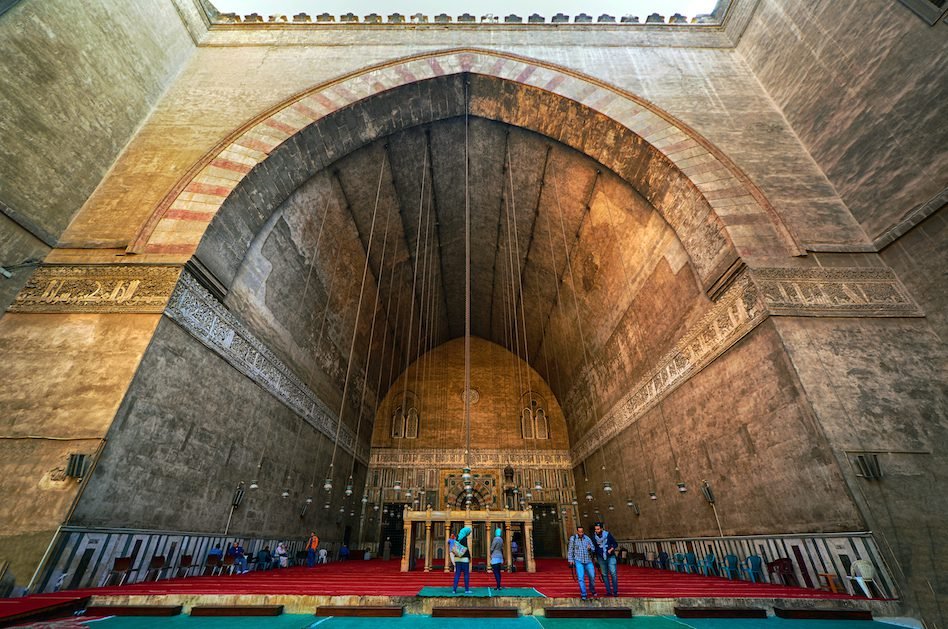
The Sultan Hassan Mosque is one of Cairo’s most outstanding historic monuments and one of the greatest examples of Mamluk architecture in Egypt. It stands in the Citadel area next to the Al-Rifai Mosque, and is known for its sheer size, its unique design, its towering walls and its decorative detail.
Renowned for its historical and architectural importance, the mosque is one of the most rewarding places to visit when exploring Islamic Cairo.
History of the Sultan Hassan Mosque
Construction of the mosque began in 1356 AD on the orders of Sultan Hassan ibn Al-Nasir Muhammad ibn Qalawun, one of the sultans of the Mamluk state in Egypt.
Building went on for several years, with great attention paid to the mosque’s size, design and architectural detail. It was intended to be a congregational mosque as well as a large religious and educational complex.
Sultan Hassan did not live to see the project finished: he died before construction was complete, and work continued after his death until the building was more or less finished in the 14th century.
Why is it called the Sultan Hassan Mosque?
The mosque takes its name from Sultan Hassan, son of Al-Nasir Muhammad, who ordered its construction during his reign.
It was part of a huge architectural project that included a mosque and schools for teaching the four Sunni schools of Islamic law, making it an important religious and educational institution as well as a place of worship.
Architecture of the Sultan Hassan Mosque
The mosque’s monumental design reflects the development of Mamluk architecture in Cairo. The building centres on a vast courtyard surrounded by large iwans (vaulted halls), together with the schools and their associated facilities.
Its façades are strikingly tall and built of stone with architectural ornament, while the interior walls feature details and inscriptions that show the skill of Mamluk-era builders and craftsmen.
Among the mosque’s most notable features are the main iwan and the spacious courtyard, as well as its domes, minarets and decorative elements.
The four madrasas of the Sultan Hassan Mosque
The mosque was designed to house schools teaching the four Sunni schools of law:
- The Hanafi school.
- The Maliki school.
- The Shafi’i school.
- The Hanbali school.
These schools show the mosque’s importance as a centre of religious learning as well as a place of worship.
The Sultan Hassan and Al-Rifai mosques
The Sultan Hassan Mosque stands right next to the Al-Rifai Mosque, and together the two form one of the most famous architectural views in the Citadel area.
Although the two mosques belong to different periods, their closeness gives visitors a chance to compare styles of Islamic architecture in Cairo across the centuries.
The Sultan Hassan Mosque and Islamic Cairo
The mosque sits in an area packed with historic landmarks that form an important part of Islamic Cairo. Around it are a number of mosques and historic buildings, as well as the Citadel of Saladin.
A visit offers a window onto an important period of Mamluk Cairo’s history and a chance to see one of its largest and most distinctive buildings.
Location on Google Maps: Sultan Hassan Mosque