-
 by
Things in Cairo
by
Things in Cairo - 2 October، 2026
- 0 Comments

Al-Zahir Baybars Mosque in Cairo is one of the capital’s most important Islamic and historic landmarks, and one of the largest historic mosques in Egypt. It stands in the El-Daher district and is named after the Mamluk sultan Al-Zahir Baybars al-Bunduqdari, one of the best-known sultans of the Bahri Mamluk state.
After many years of restoration work, the mosque reopened on 4 June 2023 following a comprehensive project to restore and rehabilitate it, with the aim of preserving its historic character and bringing it back into use both as a working mosque and as a major heritage site in Cairo.
The Al-Zahir Baybars Mosque Restoration Project
Restoration of Al-Zahir Baybars Mosque began in 2007, but the project stalled for several years before work resumed on a larger scale in 2018.
The project covered a wide range of structural and architectural work, including lowering the groundwater level, restoring the architectural and archaeological features, completing structural works, and upgrading the mosque’s lighting and security systems. During the restoration, a water cistern was also discovered beneath the floor of the mosque’s courtyard, adding a new archaeological find to the site.
The work also included several of the mosque’s iwans: the north-western iwan, covering around 1,040 square metres, and the north-eastern iwan, covering around 880 square metres, were both restored, as was the south-western iwan, which covers a similar area, along with their associated entrances.
Read more about the restoration of Al-Zahir Baybars Mosque (in Arabic)
The Republic of Kazakhstan helped fund part of the restoration, reflecting Baybars’s historic standing in Kazakh and Central Asian heritage, while the work itself was carried out under the supervision of Egypt’s antiquities authorities.
Why Is Al-Zahir Baybars Mosque Important?
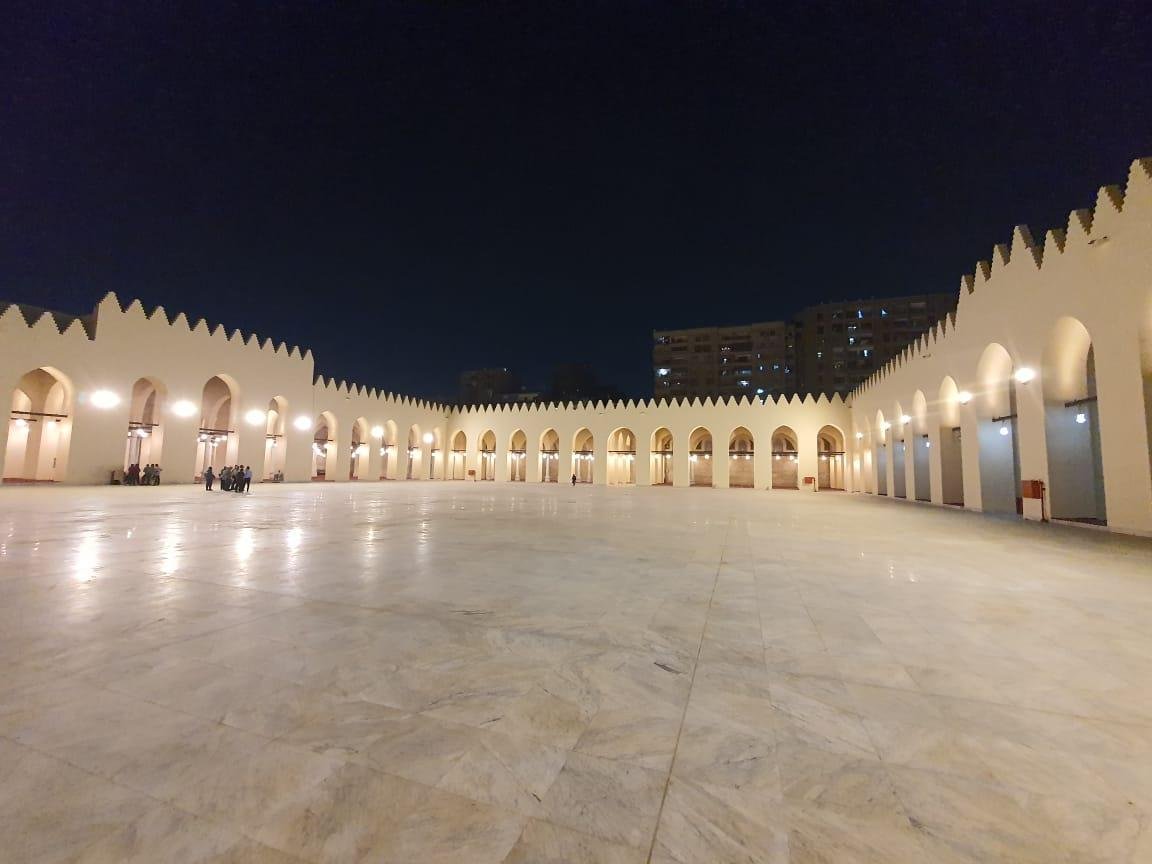
The mosque’s significance comes from its size and its architectural and historical standing. It is one of the largest historic mosques in Egypt, covering around three feddans, and ranks among the biggest historic mosques in Cairo by area.
It is built around a vast central courtyard surrounded by arcades and iwans, while massive outer walls give the building an appearance close to the defensive architecture seen in some Mamluk buildings.
The mosque measures around 106 metres long and roughly 103 metres wide, and features a series of entrances, arches and decorative elements that reflect the characteristics of Islamic architecture in the Bahri Mamluk period.
History of Al-Zahir Baybars Mosque
Sultan Al-Zahir Baybars built the mosque in the 13th century, and it became one of Cairo’s most prominent congregational mosques during the Mamluk era.
Over the following centuries, however, the mosque went through many changes: large parts of it were damaged, and it was put to different uses at different times. During the French campaign in Egypt the site was used for military purposes, before later efforts were made to preserve and restore it.
Despite everything it has been through over hundreds of years, parts of the original walls, arches and decoration still bear witness to its historic design. Official sources note that a number of carved stucco and stone decorative details have survived to this day.
The Reopening of Al-Zahir Baybars Mosque
On 4 June 2023, Al-Zahir Baybars Mosque was officially reopened after the restoration was completed, in the presence of Egyptian officials and representatives from Kazakhstan, welcoming worshippers and visitors once again after a project that lasted years.
The reopening is an important step in preserving Cairo’s Islamic heritage, particularly as the El-Daher area is home to a number of historic buildings and sites that reflect different stages in the city’s development.
Visiting Al-Zahir Baybars Mosque in Cairo
The mosque makes a rewarding stop for anyone interested in Islamic architecture and the history of Mamluk Cairo. It is not only a place of prayer but also an important record of how Cairo’s architecture developed in the 13th century.
Visitors can take in the huge courtyard, the arcades, the stone arches and the historic gateways, and learn about one of the most significant recent projects to rescue a large historic building and return it as closely as possible to its original architectural form.
You can also combine a visit to the mosque with a walk around El-Daher, Abbassia and Historic Cairo to discover more of the old mosques and Islamic buildings scattered across central Cairo.
Al-Zahir Baybars Mosque: Quick Facts
- Location: El-Daher district, Cairo.
- Period: Bahri Mamluk era.
- Founder: Sultan Al-Zahir Baybars al-Bunduqdari.
- Area: About 3 feddans.
- Restoration began: 2007.
- Main works resumed: 2018.
- Reopened: 4 June 2023.
- Key works: architectural and structural restoration, lowering of groundwater, new lighting and security systems, and restoration of the iwans and historic features.