
Mosque In Islamic Cairo
Mosque of Muhammad Ali
The alabaster mosque crowning the Citadel, Ottoman in plan and unmistakable on the skyline.
The Mosque of Muhammad Ali at the Citadel is one of Cairo’s best-known Islamic landmarks and one of the most striking historic buildings inside the Citadel of Saladin. It stands out for its distinctive Ottoman design, its great dome and its soaring minarets, and its position on the Citadel plateau offers sweeping views across Cairo.
It is also known as the Alabaster Mosque, because alabaster was used to clad large parts of its walls, and over time it has become one of Cairo’s defining architectural symbols.
History of the Mosque of Muhammad Ali
Construction began in 1830 on the orders of Muhammad Ali Pasha, founder of the Alawiyya dynasty and ruler of Egypt in the 19th century. Building went on for several years and was completed in the middle of the 19th century.
Muhammad Ali chose a site inside the Citadel of Saladin, which was then an important seat of government in Egypt. The mosque was part of the wider works carried out at the Citadel during his reign.
Why is it called the Mosque of Muhammad Ali?
The mosque is named after Muhammad Ali Pasha, who ordered it to be built inside the Citadel of Saladin. It is also known as the Alabaster Mosque because alabaster panels were used to clad its interior and exterior walls.
Architecture of the Mosque of Muhammad Ali
The design draws on Ottoman architecture, with the clear influence of the great imperial mosques of Istanbul.
A huge central dome is surrounded by semi-domes and flanked by slender, towering minarets. This gives the mosque a distinctive silhouette that can be seen from many parts of Cairo.
Inside, the walls and columns are clad in alabaster, while the decoration, inscriptions, lamps and a huge chandelier add to the grandeur of the space.
The dome of the Mosque of Muhammad Ali
The main dome is one of the mosque’s most remarkable features. It rises above the main prayer hall, surrounded by a number of smaller domes and semi-domes.
Together with the tall minarets, the vast dome gives the mosque its unmistakable shape, and it is one of the clearest examples of Ottoman influence on modern Egyptian architecture.
The tomb of Muhammad Ali Pasha
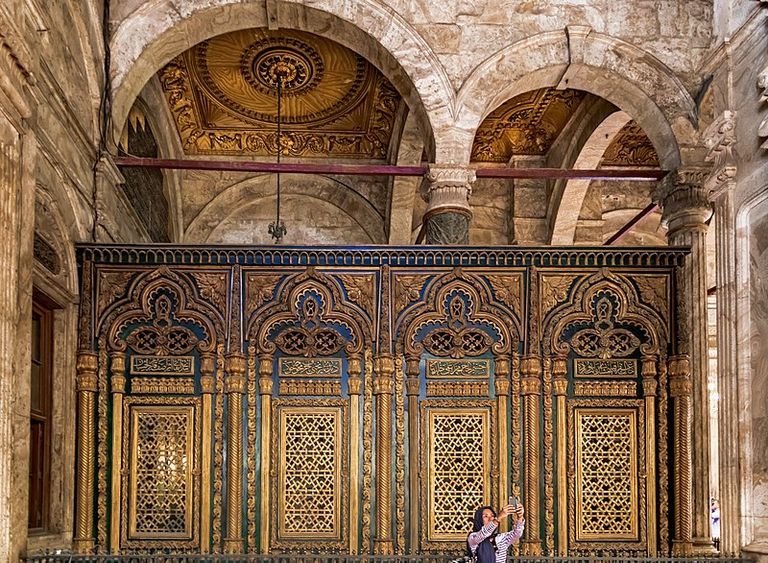
Inside the mosque is the tomb of Muhammad Ali Pasha, who was buried here after his death in 1849. The tomb lies near the entrance and is notable for its bronze grille and distinctive decoration.
It is one of the key things to see on a visit and helps tell the story of the place.
The Mosque of Muhammad Ali and the Citadel of Saladin
The mosque stands inside the Citadel of Saladin, one of Cairo’s most important historic fortresses. A visit is a chance to explore the Citadel’s other sights too, such as the Al-Nasir Muhammad Mosque, the Sulayman Pasha Al-Khadim Mosque, the museums and the historic walls.
Its elevated position also offers wonderful views over Cairo.
Views over Cairo from the Mosque of Muhammad Ali
One of the main reasons for the mosque’s fame is its lofty position above the Citadel, from where visitors can take in a broad panorama of the city. Different parts of Cairo can be seen from around the mosque, especially when visibility is good.
These views make the mosque and the Citadel favourite spots for photographers and for anyone wanting to see Cairo’s cityscape from above.
What to see at the Mosque of Muhammad Ali
Highlights in and around the mosque include:
- The huge main dome.
- The Ottoman minarets.
- The alabaster-clad walls.
- The interior decoration and inscriptions.
- The chandelier and lamps in the prayer hall.
- The tomb of Muhammad Ali Pasha.
- The views over Cairo.
- The other historic sights inside the Citadel of Saladin.
The Mosque of Muhammad Ali and Islamic Cairo
The Mosque of Muhammad Ali is an important part of the history of Islamic Cairo, even though it dates from the 19th century. It reflects a different stage in the development of Islamic architecture in Egypt, when local building was strongly influenced by the Ottoman style.
Its place inside the Citadel of Saladin makes it an essential stop on any tour of Cairo’s great historic sights.
Find it on Google Maps: Mosque of Muhammad Ali