
Mosque In Islamic Cairo
Al-Rifai Mosque
Facing Sultan Hassan across a narrow square, and holding the tombs of Egypt's royal family and of the last Shah of Iran.
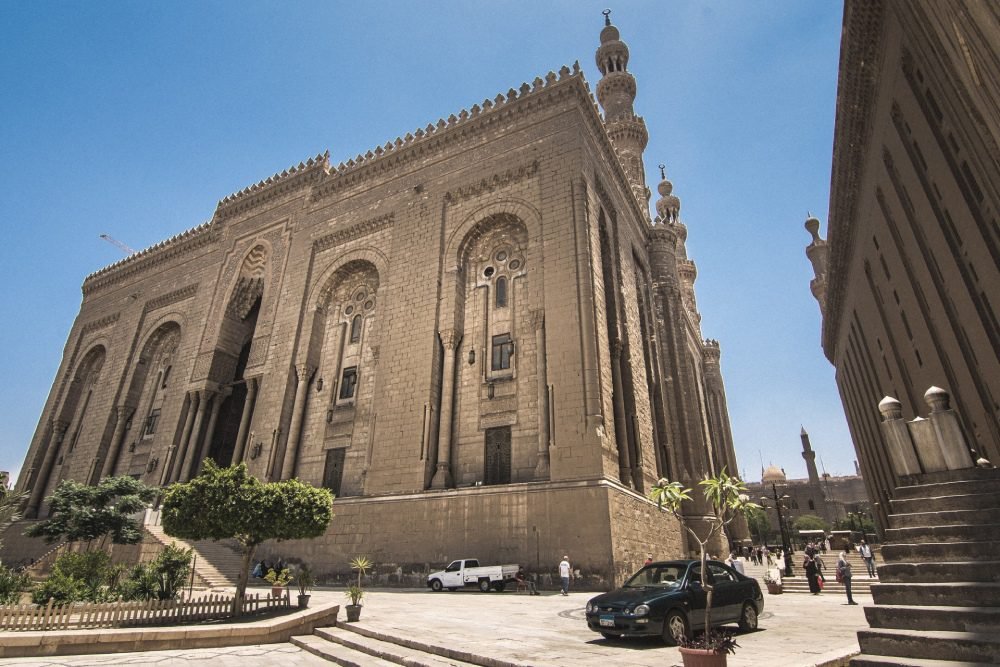
The Al-Rifai Mosque is one of Cairo’s most prominent Islamic and historic landmarks, standing in the Citadel area next to the Sultan Hassan Mosque. The mosque is known for its sheer scale and grand architecture, and it also houses the tombs of several members of the Muhammad Ali dynasty, giving it historical importance alongside its religious and architectural standing.
It is one of the top places to visit when exploring the Citadel area and Islamic Cairo, thanks to its striking location and its architectural and decorative detail.
History of the Al-Rifai Mosque
Construction of the Al-Rifai Mosque began in the nineteenth century on the orders of Khushyar Hanim, mother of Khedive Ismail, who wanted to build a large mosque and mausoleum in the Citadel area.
The project began in 1869 AD, but building work stopped for a time after the death of the mosque’s designer and some of the figures involved in the project. Work later resumed, and the mosque was completed in the early twentieth century, opening in 1912 AD during the reign of Khedive Abbas Hilmi II.
Although the mosque bears the name Al-Rifai, Sheikh Ahmed al-Rifai is not buried here; the name comes from the Rifa’i order and the symbolic shrine to the sheikh on the site.
Why Is It Called the Al-Rifai Mosque?
The mosque is named after Sheikh Ahmed al-Rifai, founder of the Rifa’i Sufi order. It was built on a site that once held a zawiya (prayer lodge) and shrine associated with the Rifa’i order, and the project later grew into the mosque we see today.
The Al-Rifai name became attached to the building and the surrounding area, even though the mosque also became the burial place of several members of the Muhammad Ali dynasty.
Architecture of the Al-Rifai Mosque
The Al-Rifai Mosque’s design blends elements of Islamic, Mamluk and Ottoman architecture, with lavish use of ornamentation, marble and coloured stone.
The façade is richly detailed, while the interior holds a vast prayer hall and a series of domes, decorations and inscriptions.
The design shows how architecture in Egypt in the nineteenth and early twentieth centuries drew on historic Islamic styles, while adding touches that were modern for the period in which it was built.
Tombs in the Al-Rifai Mosque
The mosque is also an important royal mausoleum, containing the tombs of several members of the Muhammad Ali dynasty, including:
- Khedive Ismail.
- Khedive Tawfiq.
- Sultan Hussein Kamel.
- King Fuad I.
- King Farouk.
- Other members of the Muhammad Ali dynasty.
The mosque also contains shrines associated with Sheikh Ahmed al-Rifai and other religious figures, reflecting the many religious and historical roles the building plays.
On Google Maps: Al-Rifai Mosque