Monument In Islamic Cairo
Qalawun Complex
A thirteenth-century Mamluk complex combining a madrasa, a mausoleum and a hospital, built by Sultan Qalawun along Al-Muizz Street.
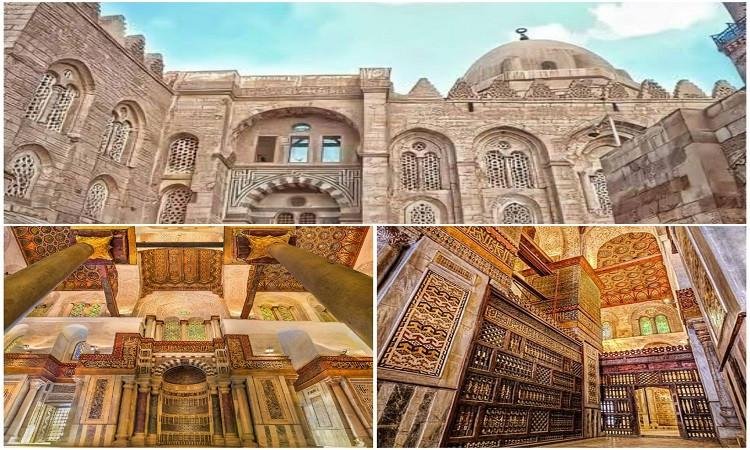
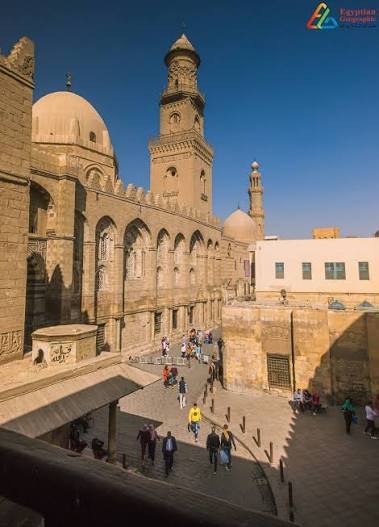
The Complex of Sultan Al-Mansur Qalawun is one of the most important and beautiful architectural ensembles on Al-Muizz Street, and one of the finest examples of Bahri Mamluk architecture in Cairo. Its importance lies not only in its beauty but in the fact that it is an integrated complex combining worship, teaching, medical care and burial in a single building at the heart of the Bayn Al-Qasrayn area.
It was built by Sultan Al-Mansur Sayf Al-Din Qalawun in around 1284–1285 AD, and comprises a madrasa, a domed mausoleum and a bimaristan (hospital) for treating the sick, along with service buildings, some of which were added later. Cairo Governorate considers the complex one of the oldest surviving examples of the multi-purpose architectural complex in the city.
Where is the Qalawun Complex?
The complex stands on Al-Muizz Street in the Gamaliya district, in the historic stretch known as Bayn Al-Qasrayn (“between the two palaces”).
This is one of the densest parts of Al-Muizz Street for monuments, with the complex surrounded by some of the most important Mamluk buildings, such as:
- The Madrasa of Sultan Al-Nasir Muhammad ibn Qalawun
- The Madrasa and Khanqah of Sultan Al-Zahir Barquq
- The Kamiliya Madrasa
- The Palace of Amir Beshtak
Its location makes the Qalawun Complex an essential stop on any tour of Islamic Cairo.
Why is the Qalawun Complex important?
Because it is not just a mosque or a school, but a complete institution that served the community in several ways.
Within a single complex there was:
- A place of prayer
- A school for religious studies
- A hospital for treating the sick
- A royal mausoleum
- Rooms and services attached to the complex
This shows how advanced charitable and religious institutions were in Mamluk Cairo, and how architecture was used to serve education, medicine and religion at the same time.
What does the Qalawun Complex consist of?
The complex is made up of three main parts:
The domed mausoleum
The madrasa
The bimaristan
There was also a drinking trough for animals beside the entrance, later replaced by a sabil (public fountain) in the reign of Sultan Al-Nasir Muhammad ibn Qalawun.
The domed mausoleum
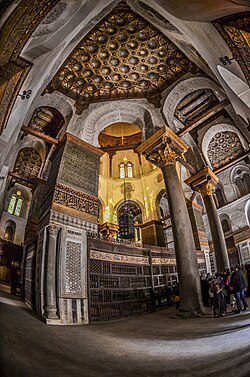
From the main entrance, the corridor on the right leads to the domed mausoleum.
Sultan Al-Mansur Qalawun is buried here, as is his son, Sultan Al-Nasir Muhammad ibn Qalawun.
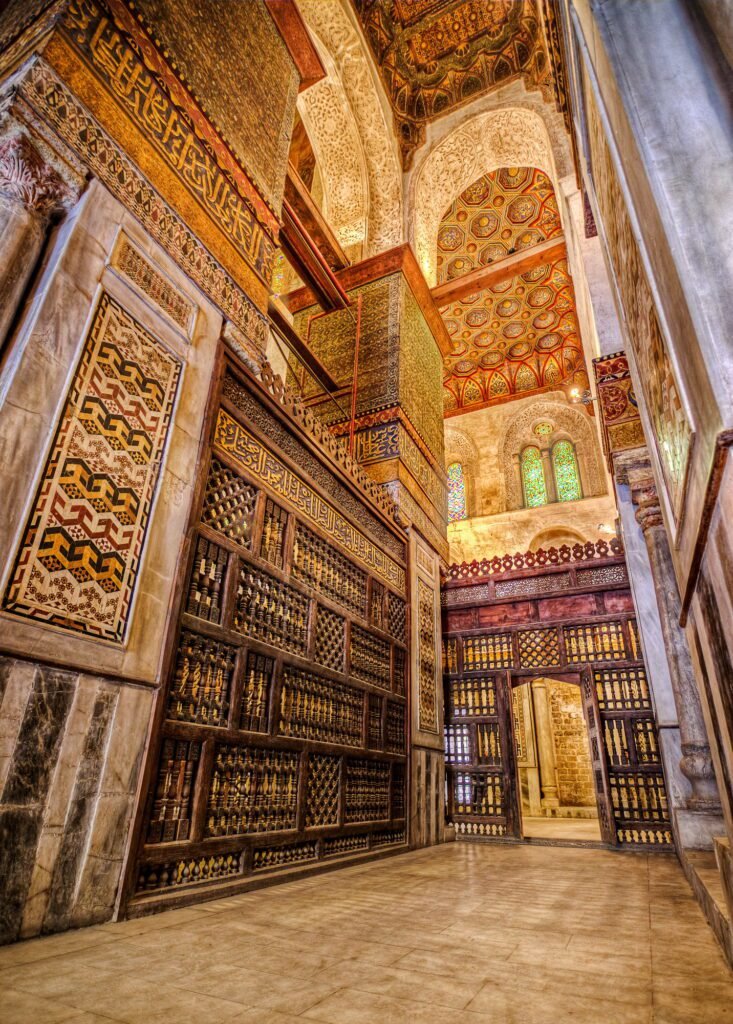
It is one of the most famous and beautiful mausoleums in Cairo, notable for its marble, ornament, woodwork and fine inscriptions.
The mausoleum is not just a burial place; artistically and architecturally, it is one of the most important parts of the complex.
The madrasa
The madrasa lies on the other side of the corridor.
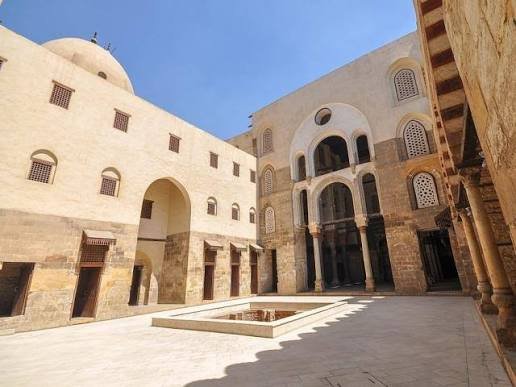
It is laid out around a central inner courtyard, with iwans (vaulted halls) set at right angles to it for teaching and prayer, and rooms that once housed students.
The madrasa was dedicated to teaching the four Sunni schools of law, reflecting the complex’s importance as a religious and educational centre at the heart of Mamluk Cairo.
The bimaristan
One of the most important parts of the complex is the bimaristan, or hospital.
It lies at the end of the inner corridor, and today only a few sections and iwans survive compared with its original size.
The bimaristan was one of the most important medical institutions in Cairo, treating patients and teaching medicine and pharmacy.
This sets the Qalawun Complex apart from most of the monuments on Al-Muizz Street, as it is tied to the history of medicine and healthcare as much as to religion and architecture.
The bimaristan and the eye hospital
In the early 20th century, the Qalawun Eye Hospital was built inside the courtyard of the old bimaristan.
This shows how the site kept its link with medicine and healing centuries after the original bimaristan was founded.
The birth of the architectural complex
The Qalawun Complex is one of the most important early examples of the architectural complex in Cairo.
Instead of building a separate mosque, school and hospital, the project brought several functions together in one connected building.
This idea later became a key feature of Mamluk architecture, especially in the great foundations built by sultans and amirs.
Why was it built at Bayn Al-Qasrayn?
Bayn Al-Qasrayn had been one of the most important parts of Cairo since the Fatimid era.
Descriptions of the complex indicate that it was built on land that was once part of the Western Fatimid Palace.
So a site once associated with the palaces of the Fatimid caliphs became a new centre of Mamluk architecture and of religious and medical institutions.
The façade
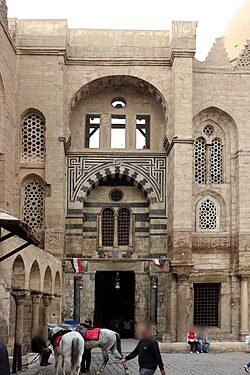
The complex’s façade is one of the most distinctive on Al-Muizz Street.
Look out for:
- Carved stone
- Tall windows
- Arches
- Inscriptions
- Marble
- Geometric and floral ornament
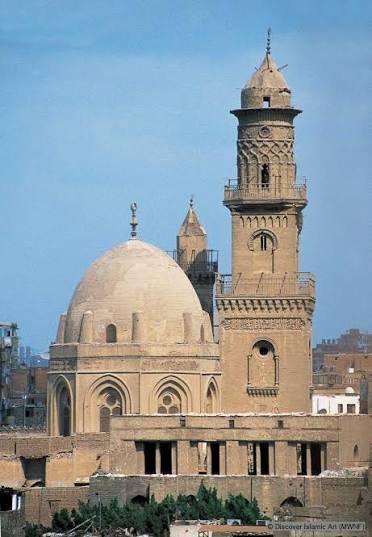
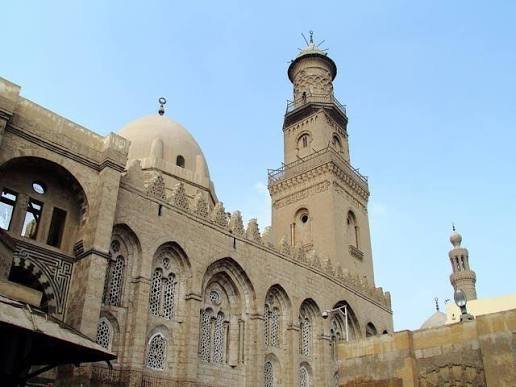
- The vertical composition of the minaret and dome
What makes the façade special is that it is not the front of one simple building: it reflects several architectural units standing side by side within the same complex.
The minaret
The minaret occupies a prominent place in the complex and contributes greatly to the streetscape of Bayn Al-Qasrayn.
From Al-Muizz Street, the interplay of the minaret, the dome and the neighbouring façades is one of the loveliest architectural views in Islamic Cairo.
Decoration inside the complex
The Qalawun Complex is notable for the variety of materials used in its decoration.
The main ones are:
- Marble
- Wood
- Stone
- Carved inscriptions
- Floral motifs
- Geometric patterns
The Ministry of Tourism and Antiquities describes the complex as notable for the precision of the decorative work carried out in these different materials.
The Qalawun Complex and the Madrasa of Al-Nasir Muhammad
Almost next door to the complex is the Madrasa of Sultan Al-Nasir Muhammad ibn Qalawun.
This creates an important historical and architectural link between the foundations of father and son in the same area.
Visiting the two together helps you understand how Mamluk architecture developed between the late 13th and early 14th centuries.
The Qalawun Complex and the Madrasa of Barquq
The Madrasa and Khanqah of Sultan Barquq also stands in Bayn Al-Qasrayn.
Comparing the two is very rewarding:
Qalawun represents Bahri Mamluk architecture of the 13th century.
Barquq, on the other hand, represents a later stage linked to the start of the Burji Mamluk era.
So within a short walk you can trace more than a century of Mamluk architecture.
The Qalawun Complex and Beshtak Palace
The Palace of Amir Beshtak is in almost the same spot.
Seeing it together with the complex shows the difference between:
- Royal religious and charitable architecture
- And the private residences of the amirs.
This makes Bayn Al-Qasrayn one of the best places in Cairo to get a broader picture of Mamluk life.
Restoration of the Qalawun Complex
The complex underwent a comprehensive restoration project that tackled a number of structural and conservation problems.
The work included:
- Lowering the groundwater level
- Strengthening the foundations
- Restoring architectural features
- Conserving the decoration
- Treating the mosaics and fine details
- Restoring the wood, marble and stone.
The restoration helped preserve one of the most important complexes of Mamluk Cairo.
Fatimid features discovered during restoration
One of the most significant findings of the restoration was the discovery that Fatimid-era wooden ceilings had been reused in parts of the complex.
These were remnants of the Fatimid palace that occupied the site before the Qalawun Complex was built, and some of the pieces were moved to the Museum of Islamic Art.
It is a striking example of how the layers of Cairo’s history overlap on a single site.
Modern lighting
The complex has also been fitted with a specialist lighting system covering:
- The outer façades
- The inner courtyards
- Some architectural features
as well as CCTV cameras on site.
This has helped bring out the details of the complex, especially in Al-Muizz Street’s night-time views.
The complex today
The complex is open to visitors as one of the leading historic sites on Al-Muizz Street.
Throughout 2026, the surrounding area continued to feature in upgrading works and efforts to improve cleanliness and order on Al-Muizz Street and around Al-Hussein.
The complex remains one of the key stops in Bayn Al-Qasrayn.
What to see on your visit
Focus on:
- The domed mausoleum
- The madrasa
- The courtyard
- The inner corridor
- The remains of the bimaristan
- The marble
- The woodwork
- The inscriptions
- The minaret
- The façade on Al-Muizz Street
It is also well worth standing back a little outside the complex to see how it relates to the neighbouring Mamluk buildings, because much of the site’s beauty lies in the complete streetscape of Bayn Al-Qasrayn.
Is the Qalawun Complex good for photography?
Yes, it is one of the best places on Al-Muizz Street for architectural photography.
Highlights include:
- The dome
- The minaret
- The windows
- The façade
- The marble interiors
- The woodwork details
- The street view with the other buildings of Bayn Al-Qasrayn
Exterior shots are especially striking thanks to the density of historic buildings around it.
Best time to visit
Morning is ideal if you want to take in the interior details in peace.
The period from just before sunset into the early evening is lovely for seeing the façades and Al-Muizz Street once the lights come on.
Entry to the site itself, however, depends on the official opening hours.
Opening hours
According to the Ministry of Tourism and Antiquities:
9am to 5pm
During Ramadan:
9am to 4pm
Last entry is one hour before closing.
Tickets
The complex is included in the Al-Muizz Street combined ticket.
Current Ministry of Tourism and Antiquities information indicates that the ticket covers the Qalawun Complex along with several other sites on Al-Muizz Street, such as:
- The Madrasa of Al-Nasir Muhammad
- The Madrasa of Barquq
- Beshtak Palace
- The Sabil of Abd Al-Rahman Katkhuda
- The Hammam of Inal
- Other sites.
That makes the combined ticket good value if you plan to visit several monuments on the same day.
How long does a visit take?
Allow about 45 minutes to an hour for the complex.
If you are interested in medical history, architecture or photography, you may need longer.
It is best combined with the Madrasa of Al-Nasir Muhammad, the Madrasa of Barquq and Beshtak Palace on the same tour.
Is the Qalawun Complex worth visiting?
Yes, absolutely.
It is one of the few sites that bring together in one place:
- Religious architecture
- Education
- Medicine
- A royal mausoleum
- Mamluk decoration
- Older Fatimid history beneath the same site
That makes it one of the richest buildings on Al-Muizz Street in historical terms.
Quick facts
Name: Complex of Sultan Al-Mansur Qalawun
Area: Gamaliya – Al-Muizz Street – Bayn Al-Qasrayn
Period: Bahri Mamluk
Built: around 1284–1285 AD
Founder: Sultan Al-Mansur Sayf Al-Din Qalawun
Main parts: madrasa, domed mausoleum, bimaristan
Historic functions: teaching, prayer, medical care, burial
What makes it special: one of the oldest multi-purpose architectural complexes in Cairo
Opening hours: 9am – 5pm
Ramadan: 9am – 4pm
Last entry: one hour before closing
Location: Al-Muizz Street – Gamaliya.
Frequently asked questions
Where is the Qalawun Complex?
It is on Al-Muizz Street in Gamaliya, in the Bayn Al-Qasrayn area.
Who built the Qalawun Complex?
It was built by Sultan Al-Mansur Sayf Al-Din Qalawun in the 13th century AD.
When was it built?
It was built in around 1284–1285 AD.
What is inside the Qalawun Complex?
It contains a madrasa, a domed mausoleum and a bimaristan, along with other service buildings.
What is a bimaristan?
A bimaristan is a historic hospital for treating the sick, which was also linked to the teaching of medicine and pharmacy.
Who is buried in Qalawun’s mausoleum?
Sultan Al-Mansur Qalawun and his son Al-Nasir Muhammad ibn Qalawun are buried there.
Is the Qalawun Complex a mosque?
It is not just a mosque but an architectural complex comprising a madrasa, a mausoleum and a bimaristan; the madrasa was also used for prayer.
Is the complex open to visitors?
Yes, it is officially listed among the archaeological sites open to visitors.
What are the opening hours?
9am to 5pm, and 9am to 4pm during Ramadan.
Is there a combined ticket for Al-Muizz Street?
Yes, the Qalawun Complex is included in a combined ticket covering a number of monuments on Al-Muizz Street.
Has the Qalawun Complex been restored?
Yes, it underwent a comprehensive restoration that included tackling groundwater, strengthening the foundations and restoring architectural and decorative features.
What is near the Qalawun Complex?
Highlights include the Madrasa of Al-Nasir Muhammad, the Madrasa of Sultan Barquq, Beshtak Palace, the Al-Aqmar Mosque and the whole of Al-Muizz Street.
How long does a visit take?
Usually 45 minutes to an hour, though you may need longer if you are interested in the architectural details or the history of the bimaristan.
Can I visit the complex as part of an Al-Muizz Street tour?
Yes, and that is the best way to see it, as it sits at the heart of one of the richest stretches of Al-Muizz Street.
Location on Google Maps: Qalawun Complex