
Monument In El Haram
The Great Sphinx
Carved from a single ridge of limestone below the plateau, guarding the causeway of Khafre.
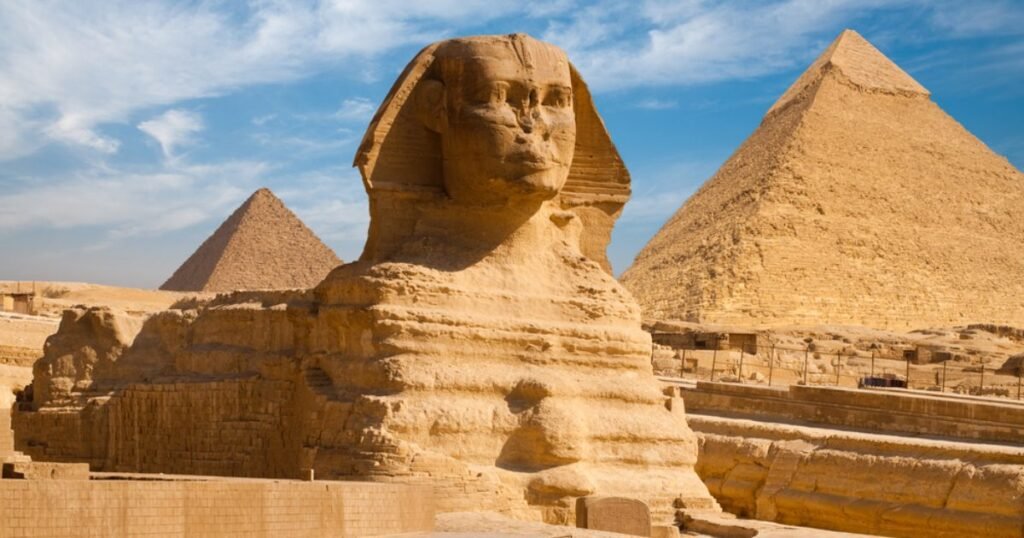
The Sphinx has looked out from the Giza Plateau for thousands of years, as if it were still guarding the area around the pyramids just as it did in ancient Egypt. The statue sits in front of the Pyramid of Khafre and is one of the most famous ancient Egyptian monuments, and one of the landmarks most closely tied to the name of Giza.
Although the Pyramids of Giza steal the show with their size, the Sphinx has a presence all its own. Its great size, its features carved out of the bedrock and its position in front of the pyramids make standing before it an essential part of any visit to Giza.
The Great Sphinx of Giza is a colossal statue carved directly from part of the natural limestone of the Giza Plateau. It depicts a creature with the body of a lion and the head of a man wearing the royal headdress.
The statue is about 73 metres long and around 20 metres high. It is widely believed to bear the features of King Khafre, whose name is linked to the second pyramid in the Giza group, although scholarly debate continues over some details of the statue’s identity and date.
According to the Ministry of Tourism and Antiquities, the Sphinx was carved during the Fourth Dynasty and is linked to King Khafre’s funerary complex.
Why is it called Abu al-Hol?
“Abu al-Hol” (roughly “Father of Terror”) is the well-known Arabic name for the statue; it was not the name the ancient Egyptians used when it was built.
In ancient Egypt the statue’s image was associated with strength and protection, and the lion was linked to kingship and power. Over thousands of years the names and interpretations attached to the statue have changed, but its image has remained one of the best-known symbols of ancient Egyptian civilisation.
What happened to the Sphinx’s nose?
One of the questions visitors hear most often about the statue is: where did the Sphinx’s nose go?
There is no confirmed historical answer identifying who was responsible for the loss of the nose. Many popular stories have grown up around it, but some of them are not supported by reliable historical evidence.
What is certain is that the statue has suffered from erosion and damage over many centuries, and that a large part of it was buried under sand at various points in its history before excavation and restoration work.
Was the Sphinx buried in sand?
Yes, large parts of the Sphinx remained buried under sand for long periods.
One of the best-known stories connected with the statue is the Dream Stela of King Thutmose IV, which he set up in front of the Sphinx. It tells of a vision the king had in his sleep while he was still a prince.
The stela is one of the most important historical sources on the Sphinx, and it also indicates that the statue was partly buried in sand at that time.
The best time to visit the Sphinx
You can visit the Sphinx as part of a tour of the Giza Pyramids site. The best time to go depends on the weather and how well you cope with heat, especially in the summer months.
Early morning is usually a comfortable choice if you want to explore before temperatures rise, and the morning light shows off the statue and the pyramids behind it nicely for photos.
If photography is your main aim, it is worth setting aside separate time for the Sphinx rather than just glancing at it on your way between the pyramids.