
Monument In El Haram
Pyramids of Giza
The last of the seven wonders of the ancient world still standing: Khufu, Khafre and Menkaure on the desert plateau at the western edge of the city.
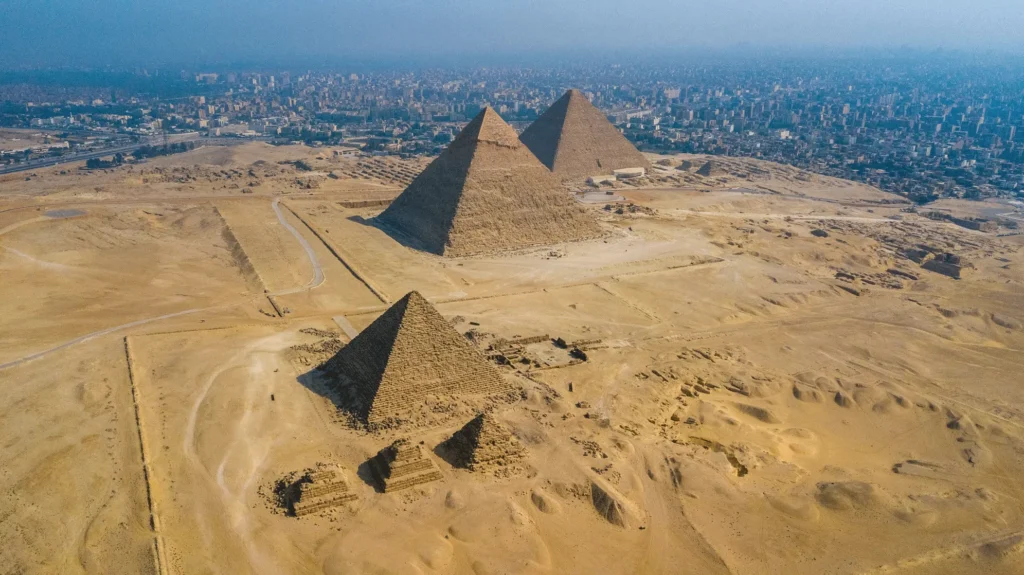
On the Giza Plateau, a short distance from Cairo, the pyramids of Khufu, Khafre and Menkaure have stood for more than four thousand years, alongside the Sphinx and a large group of tombs, temples and structures linked to the pyramid complexes. The area forms part of the “Memphis and its Necropolis” site, inscribed on the UNESCO World Heritage List since 1979.
The main group of Giza pyramids consists of three royal pyramids built during the Fourth Dynasty of ancient Egypt:
- The Pyramid of Khufu, known as the Great Pyramid
- The Pyramid of Khafre
- The Pyramid of Menkaure
The pyramids were never stand-alone buildings; each was part of a complete funerary complex with temples, causeways, tombs and other structures. Around the pyramids you will also find tombs of senior officials and members of the royal family, as well as finds linked to the site such as the Khufu boats.
The Great Pyramid: the Pyramid of Khufu
Stand in front of the Great Pyramid for the first time and it is hard to notice anything before its sheer size. When it was built, King Khufu’s pyramid stood around 146.5 metres tall, and it remained the tallest man-made structure for about 3,800 years. Today it is still the only surviving wonder of the Seven Wonders of the Ancient World.
Inside, the pyramid has a complex layout with three chambers, including the King’s Chamber within the body of the pyramid, reached via the “Grand Gallery”. Even today there is no fully confirmed answer as to exactly how the pyramid was built, which is one reason its engineering has attracted so much interest and study over the years.
The Pyramid of Khafre
Seen from a distance, the Pyramid of Khafre can look taller than the Great Pyramid, but it is actually lower. Part of that impression comes from it standing on higher ground.
The pyramid was built for King Khafre, Khufu’s son, and originally stood around 143.5 metres tall. One of its most distinctive features is that its tip still keeps part of its original limestone casing, which gives it the shape it is known for today. Khafre’s complex is also linked to the Great Sphinx.
The Pyramid of Menkaure
The Pyramid of Menkaure is the smallest of the three main pyramids. It was built by King Menkaure, Khafre’s son and Khufu’s grandson.
It originally stood around 65 metres tall, and granite was used for parts of its outer casing, stone brought from Aswan more than 800 kilometres away. Its different size and building materials give another view of how royal architecture developed during this period.
The Great Sphinx
No visit to the Pyramids of Giza is complete without stopping at the Great Sphinx.
The statue sits within Khafre’s complex and is one of the most famous symbols of ancient Egyptian civilisation. Seen together with the pyramid, the mortuary temple and the other buildings of the complex, it gives the area a different feel: you are not looking at three separate pyramids, but at the remains of a complete archaeological complex.
What to see at the Pyramids
Visiting the Pyramids of Giza is about more than standing in front of the three pyramids. The archaeological site holds a wide range of monuments to explore, including:
- The Great Pyramid of Khufu
- The Pyramid of Khafre
- The Pyramid of Menkaure
- The Great Sphinx
- The mortuary temples
- The causeways linked to the pyramid complexes
- Tombs of royal family members and senior officials
- The Khufu boats
- Other monuments and tombs scattered across the Giza Plateau
According to the Ministry of Tourism and Antiquities, besides the main pyramids the Giza Plateau also includes queens’ pyramids, tombs, mastabas and a range of monuments linked to the royal complexes.
Why visit the Pyramids?
You may have seen thousands of photos of the pyramids before you visit, but seeing them in person is something else entirely.
The size of the blocks, the height of the pyramids, the distances between the structures and the sheer expanse of the plateau are all hard to capture in a single photo. Above all, the site does not tell the story of a single pyramid; it tells a large part of the story of architecture, royal burial and life in ancient Egypt.
The Great Pyramid in particular is not just a famous Egyptian monument; it is the last of the wonders of the ancient world still standing, and the pyramid area is part of the World Heritage Site “Memphis and its Necropolis: the Pyramid Fields from Giza to Dahshur”.
The best way to explore the Pyramids of Giza
If this is your first visit, allow enough time to explore the plateau rather than just taking photos from one spot. Start with the three pyramids, then head to the Sphinx and the complexes linked to the Pyramid of Khafre.
If you are interested in history, try reading a little about each pyramid before you arrive; you will notice differences in design, location and materials instead of seeing the pyramids as three similar buildings.