
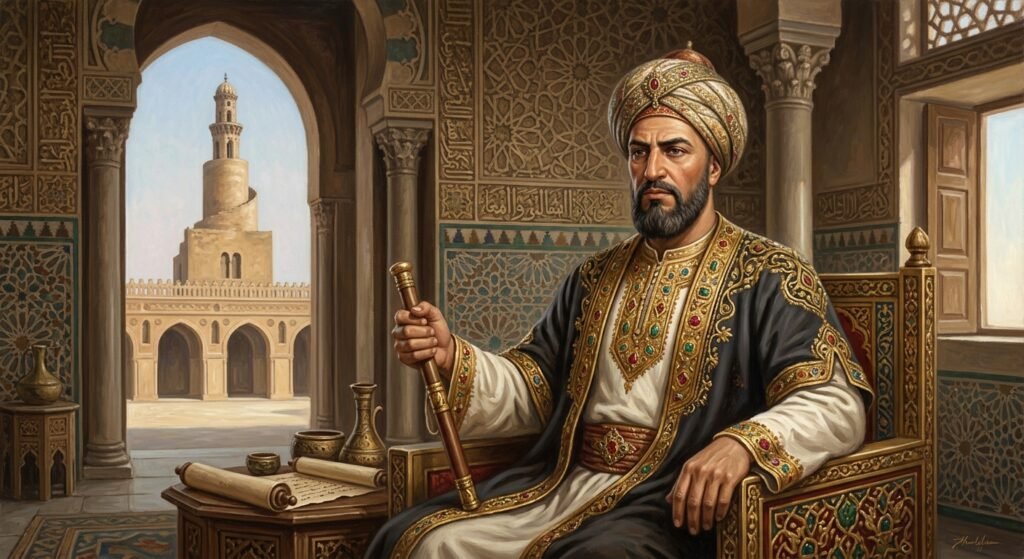
Who was Ahmad ibn Tulun?
Ahmad ibn Tulun came to Egypt as a governor under the Abbasid caliphate, then built up such wide authority that his rule came close to real independence. Rather than simply govern from the existing capital, he founded the city of al-Qata'i as a new seat of government, army and administration, extending the built-up area north-east of al-Askar.
In Cairo's memory his name is tied to his great mosque more than to anything else. Construction began in 263 AH and was completed in 265 AH; it became the main mosque of al-Qata'i and one of the clearest surviving examples of Islamic architecture from the 3rd century AH.
How did they shape Cairo?
Ibn Tulun's importance to Cairo goes beyond a single building: al-Qata'i marked a whole stage in the shifting and growth of the city's centre. Most of it has disappeared, but the mosque survives as a massive architectural block that preserves a rare early plan and shows how the new ruler wanted to give his capital an identity of its own, separate from the centres that came before.
The mosque's location today, near Saliba Street and Sayeda Zeinab, keeps Ibn Tulun present inside the historic fabric of the city – not as an isolated monument, but as the start of a chain of buildings that later grew up in the same area.
Monuments linked to Ahmad ibn Tulun
Where to see their legacy today
Start at the Mosque of Ahmad ibn Tulun, then head to Saliba Street, where Mamluk and Ottoman monuments built centuries later follow one after another, and you can see the layers of historic Cairo within a short walk.