
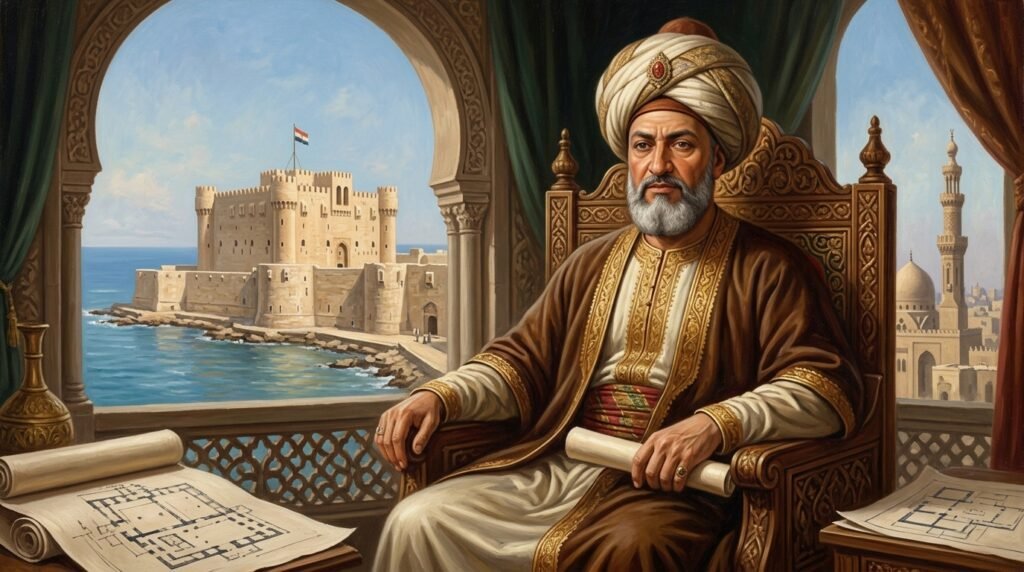
Who was Al-Ashraf Qaitbay?
Al-Ashraf Qaitbay ruled for about three decades, a relatively long time for the Circassian Mamluk era. His name is linked to a wide network of buildings in Egypt and beyond, and in Cairo the standout is his complex in the Mamluk desert cemetery, built between 877 and 879 AH.
The complex includes a madrasa, a sabil, a kuttab and a burial place for the sultan's family, and is famous for its richly carved stone dome, its minaret and fine details that have made it one of the best-known images of Mamluk Cairo.
How did they shape Cairo?
Under Qaitbay, funerary architecture in the Mamluk cemetery reached a high level of precision and harmony. The complex does not stand alone: set among other domes, madrasas and khanqahs, it is the visual centre of a whole area.
Qaitbay is also linked to renovations of earlier buildings, including work on the mausoleum of Imam al-Shafi'i, which shows that sultans looked after heritage as well as building anew.
Monuments linked to Al-Ashraf Qaitbay
Where to see their legacy today
Make Qaitbay's complex the focus of a tour of the Mamluk cemetery, then link it with the khanqah of Faraj ibn Barquq and the nearby buildings to see how funerary architecture developed during the 9th century AH.