
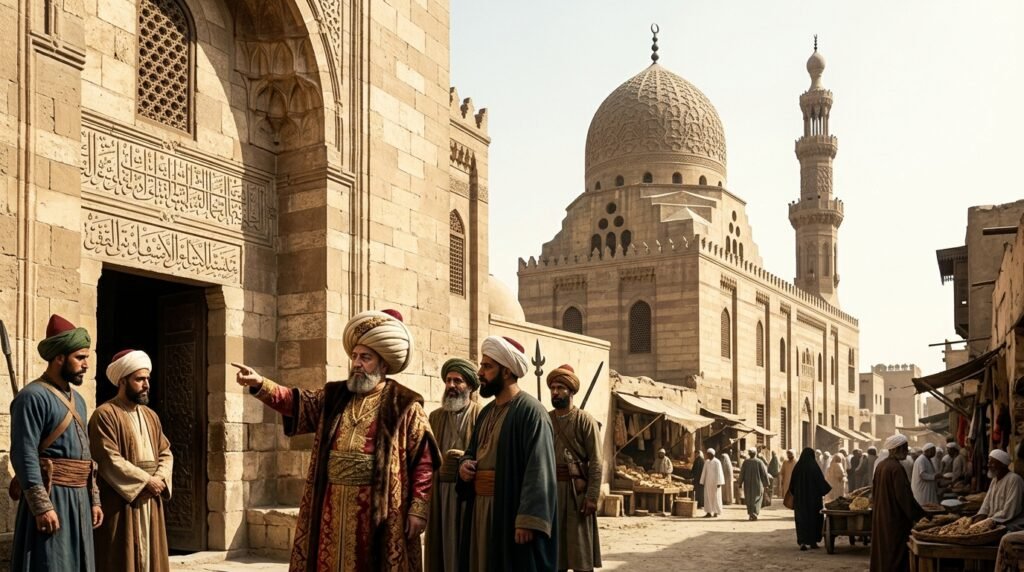
Who was Al-Ashraf Barsbay?
Al-Ashraf Barsbay became sultan after al-Mu'ayyad Shaykh, and his reign was marked by wide economic and military activity and by many building projects. On al-Muizz Street, in 829 AH, he founded a madrasa that combined teaching, prayer and Sufism, with a sabil, a Qur'an school (kuttab) and facilities for students.
Barsbay chose to be buried in another foundation in the Mamluk cemetery, which links his name to two different centres of Mamluk architecture in Cairo.
How did they shape Cairo?
Barsbay's buildings show that an architectural endowment was a network rather than a single building. The madrasa on al-Muizz Street served learning and worship in the heart of the city, while the funerary complex east of Cairo reflects the cemeteries' transformation into an organised urban area.
This geographical spread makes his story useful for understanding how far Mamluk Cairo extended in the 9th century AH.
Monuments linked to Al-Ashraf Barsbay
Where to see their legacy today
Start with his madrasa on al-Muizz Street, then, on another outing, go to the Mamluk cemetery to connect the educational side of his legacy with the funerary side.