
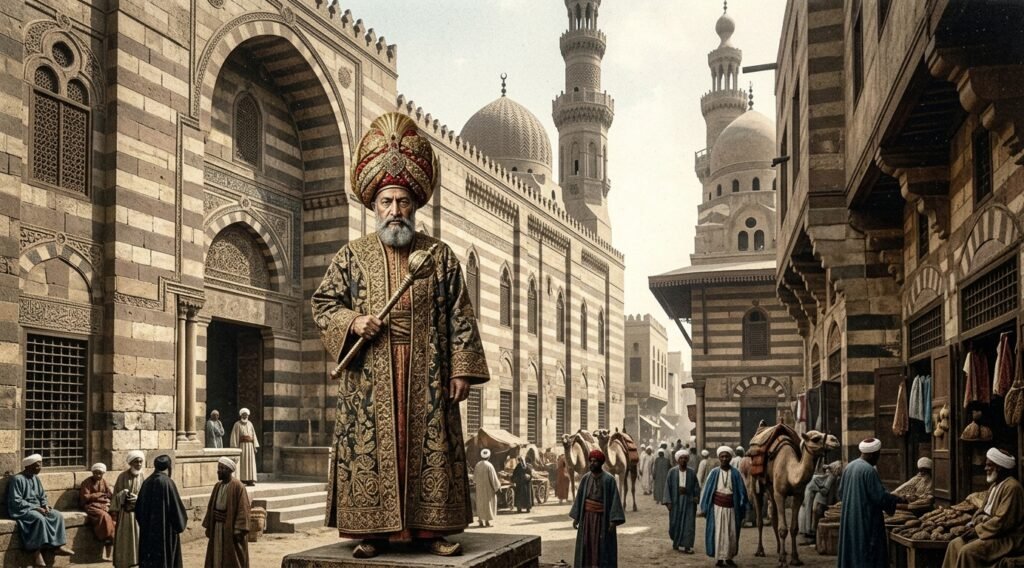
Who was Qansuh al-Ghuri?
Qansuh al-Ghuri became sultan in 906 AH and ruled until he was killed at the Battle of Marj Dabiq in 922 AH. In Cairo, between 909 and 910 AH, he built a complete architectural complex that became the heart of the area named after him, al-Ghuriya.
The complex included a mosque, a madrasa, a domed mausoleum, a khanqah, a sabil, a kuttab, a loggia and a house, and was also tied to commercial activity around it. Although the dome was prepared as the sultan's tomb, he was not buried there after his death in Syria.
How did they shape Cairo?
The al-Ghuri complex represents a late high point of Mamluk architecture before the move to Ottoman rule. Divided across both sides of the street and bringing many functions together in one place, it is one of the most complete urban complexes in Cairo.
The markets and cultural activity that continue in the area also give it a modern life, so it does not feel like a monument cut off from today's city.
Monuments linked to Qansuh al-Ghuri
Where to see their legacy today
Start at the al-Ghuri complex, then move on to Wikalat al-Ghuri, the markets of al-Ghuriya and Bab Zuweila. The route brings royal architecture together with trade and crafts in one of the busiest parts of Cairo.