
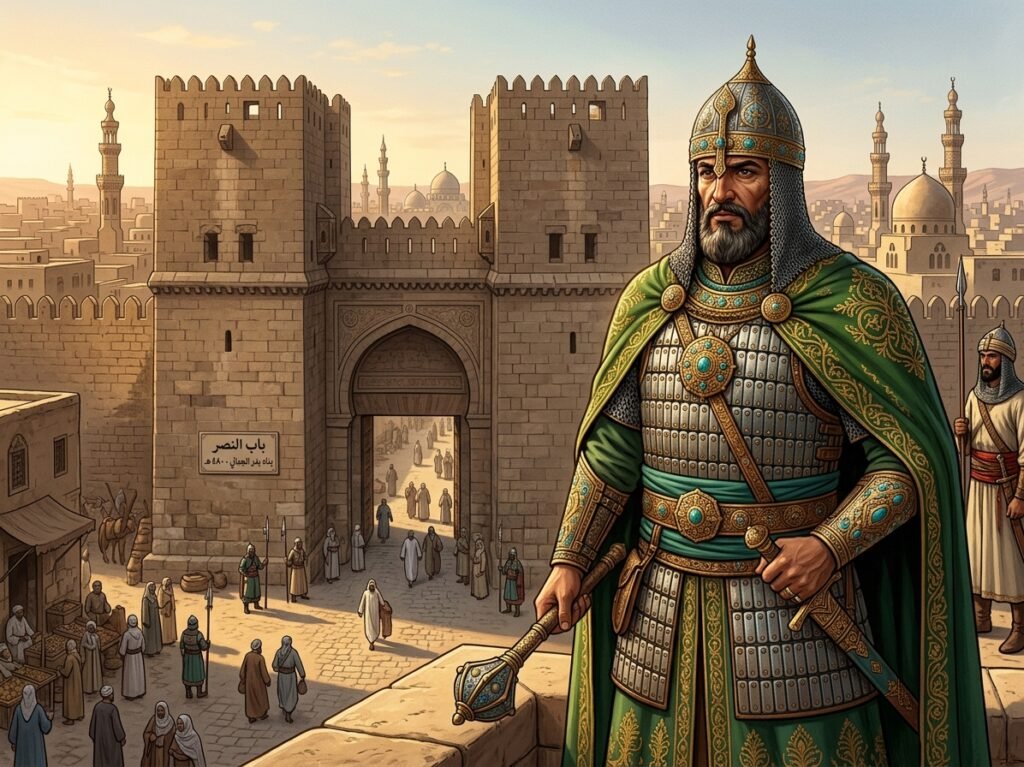
Who was Badr al-Jamali?
Badr al-Jamali came to Egypt during a difficult period in the reign of al-Mustansir bi-Allah and took on the roles of vizier and commander of the armies. One of his most important building projects was to rebuild Cairo's walls in stone and enlarge the city, replacing the older walls built under Jawhar al-Siqilli.
He entrusted the work to skilled builders, and it produced the massive gates that survive today: Bab al-Futuh and Bab al-Nasr in the north, and Bab Zuweila in the south.
How did they shape Cairo?
Badr al-Jamali's influence is very clear in the everyday experience of al-Muizz Street: entering the street from the north or leaving it to the south means passing through parts of his project. The expansion also brought the Mosque of al-Hakim bi-Amr Allah inside the wall, after it had stood outside Jawhar's old one.
This link between fortification and city-building makes Badr al-Jamali one of the people who most shaped the physical form of Fatimid Cairo that later generations inherited.
Monuments linked to Badr al-Jamali
Where to see their legacy today
Start at Bab al-Nasr, move on to Bab al-Futuh, then walk towards Bab Zuweila. The route connects three of the most important parts of the project Badr al-Jamali oversaw.